EARTH-HOUSE POIESIS
WITNESSING – DOCUMENTING – STORYING
2026-27
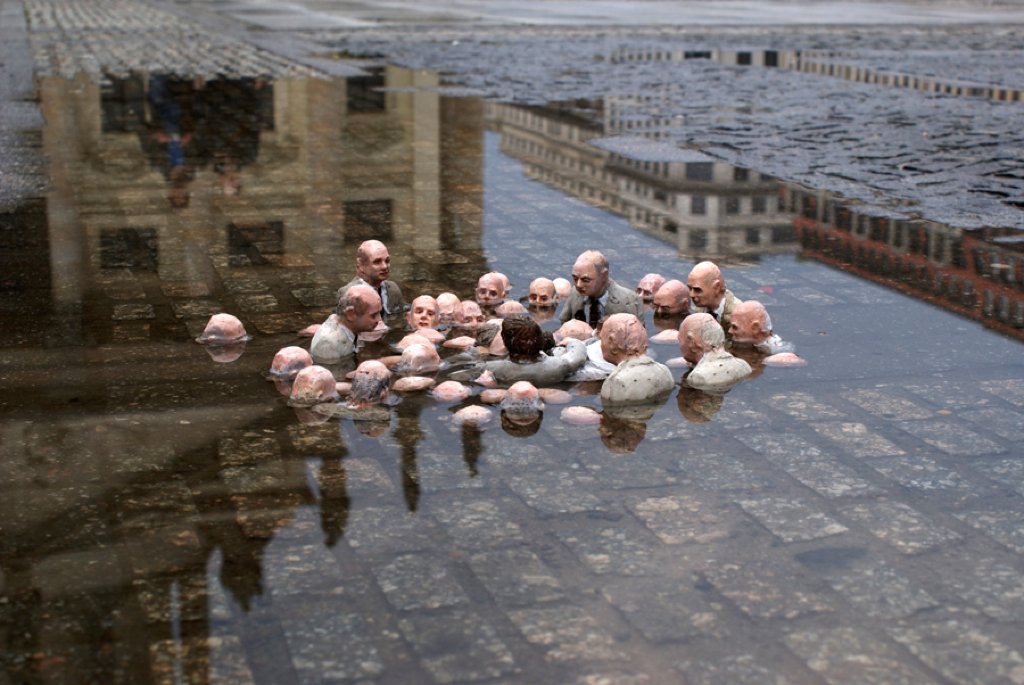
Isaac Cordal, “Follow the leaders,” Berlin, 2011
THE COURSE
Earth-House Poiesis is the New School’s radical new transdisciplinary course in the Environmental Arts and Humanities. It explores how we might actively respond to, interpret and generate new understandings of an epoch defined by morbid-stage capitalism and its irreversible human impact on earth systems; and how we might then work towards the re-enchantment of the world.
Our curriculum fosters a critical-creative stance towards social, ecological and epistemic crisis, recovering the word’s origins as “decision” or “turning point:” a means of rejuvenating possibilities for flourishing within the more-than-human assembly within which we are entangled. The title admiringly conjures Gary Snyder’s landmark 1969 volume, Earth House Hold, with its play on the root meaning of “ecology” and concern with “growth and enlightenment in self-disciplined freedom.”
Our material is art, which we consider a mythopoetic force for change as well as tactical media. In practice, this means theoretically-inflected acts of witness, diagnosis and making through narrative, documentary, performance and exhibition that map contemporary urgencies and opportunities. A 400-year old story is coming to an end. Once more, we must make it new!
Ecology, from German Oecologie (E. Haeckel, Generelle Morphologie); taken from ancient Greek οἶκος, “house, dwelling.” (1866)
Story, from Anglo-Norman storie (also estorie, istorie), “The series of past events considered as a sequential narrative; the facts of the matter.” (1225)
Document, from Latin documentum “lesson, proof”; from docere “teach”; "to show, teach, cause; to support by documentary evidence." (1500)
Poiesis, from ancient Greek ποίησις “creation, production; to make; to bring forth.” (1851)
RATIONALE
The Earth-House Poesis curriculum aims to open the wealth of expressive possibilities available to students, who we consider to be scholars of primary sources that use art as a sharp instrument for exploring complex cultural fields. We regard everyone as an energetic researcher from the very start of her or his time at the New School.
At the core of NSotA’s pedagogy is the project, a “throwing forward,” a self-directed act of discovery, organisation and meaning-making. Accordingly, a project may be considered a feminist figuration or place of gathering; or fieldnotes mined within the critical-creative seam; or discovered and retrieved materials subjected to adventurous shaping into narrative form.
As such, the course invites students to think about how more traditional forms of critical enquiry can be woven into feral creative forms such as collage or combines, accommodating materials drawn from multiple disciplines and contexts, often with a stress on the imaginative use of archives in representing threatened habitats.
Students will be inspired to emulate intermedia developments in 21st Century documentary and story-making practice, which comprise hybrid assemblages of text, textile, moving image, music, sound design, performance, oral testimony and immersive environments in any variety of non-prescribed combinations. We welcome-in ideas and materials drawn from traditions both formal and fugitive.
The emerging work might be foreign to the category of completion or what Roland Barthes desribes as an artform “drawn towards an unknown praxis,” beyond accepted criteria. The approach is encapsulated in Mythrill’s non-exhaustive genealogy tracing the lineage of art as investigation from U.S. Civil War battlefield photography to Forensic Architecture and open-source intelligence.
The results will be published on our website and, where appropriate, in material form and exhibited as an act of civic engagement at our end-of-year September art show, which contributes to the London Design Festival. The activities of the e-flux online journal and the Documents of Contemporary Art anthologies published by the Whitechapel Gallery and MIT Press between 2006 and the present indicate the level of engagement.
“What would a science or body of knowledge be like, which instead of invoking the criteria of repeatability and the guarantee of outcomes required for industrial and technological efficiency, sought endlessly to experiment without drawing conclusions, without seeking law-like regularities? Would such a science approximate the singularity and uniqueness of art or intuition? Could experimental techniques themselves be derived experimentally, artistically, inventively, non-teleologically? What would an ethics be like, which instead of seeking a mode of equivalence, a mode of reciprocity or calculation, sought to base itself on absolute generosity, absolute gift, expenditure without return, a pure propulsion into a future that does not rebound with the echoes of an exchange dictated by the past? These questions, when posed acutely and intensely enough, when posed in a timely, which is perhaps to say, in Nietzschean terms, an untimely fashion, may provoke new modes of knowing, being, responding and initiating.”
--Elizabeth Grosz, Becomings: Explorations in Time, Memory and Futures (1999)
“[T]he ‘double fracture of modernity,’ is a divide that, to a fault, separates environmental histories, theories, and issues from the histories and theories of colonialism and slavery and their resistances. I argue that facing environmental issues such as ecocide requires moving beyond this double fracture both in the present and in the past. One cannot effectively preserve the environment without engaging with the long historical logics that cause its destruction, and vice versa. One cannot think about the emancipation process without looking at how the uses of the environment in turn exacerbate the suffering of the dominated. What does it mean to be free from slavery if this freedom is to be lived in a toxicant-ridden island or an unbreathable city?”
--Malcom Ferdinand, Decolonial Ecology: Thinking from the Caribbean World (2021)
“Stories need spaces, free to access and enjoy: shelters. We all know that stories can be used to entrench prejudice and suspicion, especially when slurs and falsehoods rampage through social media unchecked. Calling lies lies will not suffice. Only more stories, illuminating, reinvigorating, exploratory, different stories, can oppose the disinformation and rumour-mongering, and the repertoire is vast, waiting to be reanimated.”
--Marina Warner, Introduction to The Shelter of Stories (2025)
“New technologies, realigned social relations, and emerging political challenges call for a reexamination of documentary’s forms, functions, and roles. No longer a fixed object, documentary is taking on iterative, shape-shifting contours and migrating across multiple interfaces.”
--Patricia R. Zimmermann & Helen De Michel, Open Space New Media Documentary (2018)
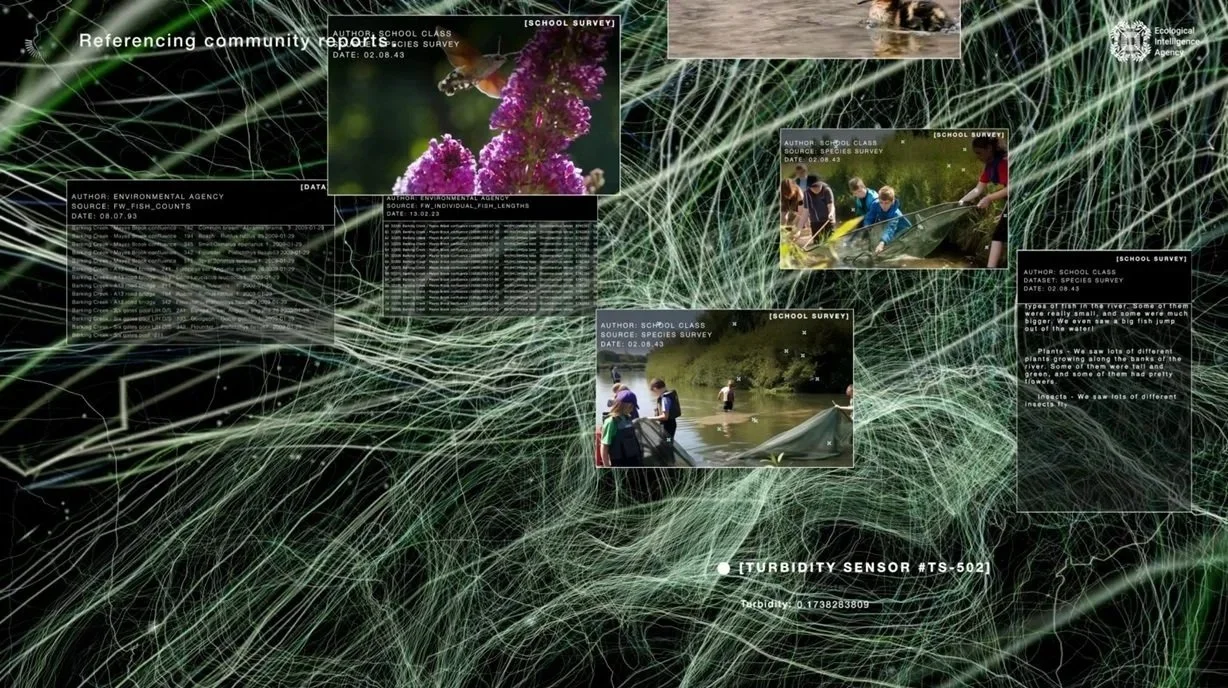
Superflux, “The Ecological Intelligence Agency” (2023)
REFERENTIAL FIELD
Our context is the era of polycrisis: Edgar Morin’s term for the seemingly disparate shocks across the ecology and geopolitics that should more properly be regarded as intersecting biopolitical forces.
In the century’s third decade, these are most visibly characterised by the irreversible harm caused to the earth’s life-support systems by the extractivist imperative, climate injustice across the Global South, genocide in Palestine and Sudan, imperialist wars in Ukraine and Yemen, enforced displacement and migration, grotesque levels of sanctioned inequality and poverty, and the loss of confidence in structures of civic administration.
All of which is underscored by the lawlessness and lies of a fascist resurgence, the expanding sphere of techno-feudalist domination machines, the despoilation of discursive public space, the transnational dismantling of nuclear-weapon limitation treaties, the pauperisation of labour and the asocial deregulations of capital. The list, unfortunately, is far from exhaustive . . .
From such confrontations we might broach a Post-Anthropocene imaginary by charting generative new relationships between humans, technology and earth others that are rooted in an ethics of vigilance, reciprocity and care; and enacting the Iroquois (Haudenosaunee) Seven Generations Principle of working for the well-being of our descendants 100 years hence.
The subject focus is therefore without boundary or limit. Biome stress, species extinction, soil degradation, neocolonial landgrab, community dismantling, susbtrate-memory deletion: all such themes and many more lend themselves to fine-grained case studies that must extend to narrating the many compelling examples of mobilised resistance and speculative models of a liveable ‘otherwise’ within a shared biographical habitat.
And so, no matter how challenging the situation might be, we refuse to sacrifice tenderness! As Jodi Dean observes, “If all we can do is evaluate, critique, or demystify the present, then what is it that we are hoping to accomplish?” We need both critique and positive formulations of alternatives which, notes Jane Bennett, “will themselves become the objects of later critique and reform.”
Our point of departure is the constellational, historicising work of intermedia practitioners such as the Otolith Group, Forensic Architecture, Superflux, John Akomfrah and former members of the Black Audo Film Collective, Isaac Julien, Carolee Schneemann, Earshot, Raqs Media Collective, Alan Sekula, Chris Marker and Frederick Baker, all of whom are (or were) concerned with the use of visual design, alongside more established media of text and screen as a means of engaging participant-viewers with networks of contemporary epistemic pressures.

Jeremy Deller’s The Battle of Orgreave Archive (An injury to One is an Injury to All) (2001), LaToya Ruby Frazier’s Flint is Family (2016), Mathieu Asselin, Monsanto: A Photographic Investigation (2016), Patrick Keiller’s Robinson Institute (2017), Anselm Kiefer’s Finnegans Wake (2023), Hannah Perry’s Manual Labour (2024), Tanoa Sasraku’s Morale Patch (2025), Edward George’s Black Atlas (2025) Daniel Ward’s Lonesome Ghosts (2025), Naeem Mohaiemen’s Through a Mirror Darkly (2025) and NSotA Ensemble member, D-Fuse/Mike Faulkner’s Nine Earths (2025) are more localised, diverse and recent examples of mixed-media documentary performance.
While photographic/filmic and more overtly given to a single-disciplinary orientation, the international Earth Photo competition created by Forestry England, the Royal Geographical Society and Parker Harris is also exemplary in its innovative visual storytelling of biosphere systems crisis.
Whether you’re an aspiring poet, writer, painter, scholar, filmmaker, mixed-media assembler, dancer, sculptor, textile-artist, musician, designer, dramiturg, cook, carer, community organiser, subvertiser, mechanic, gardener, forester, builder and/or ecologist, you’ll have a part to play.
TEACHING ARRANGEMENTS
Students participate in a varied programme of twice-weekly online seminars, which forms the connective tissue of the course. All of these emphasise theoretically-inflected practice. The year will include classes on composition, worlding, fabulation, futures literacy, Antarctic rights, food sovereignty, racial capitalism, biome site-writing, global infrastructures, surveillance capitalism, degrowth economics and spatial practice, as well as introductory sessions on formulating an enquiry and interdisciplinary methodologies.
As the Autumn term progresses, students will be encouraged to assemble in small groups around collectively-chosen project-based case studies. These will be closely supervised over the ensuing months by academics and practitioners drawn from the Ensemble.
Peer Accompaniment for Research
The course brings into confluence the existing approach of the New School with a collaborative practice dedicated to social inquiry developed over many years by the Research-in Action Community of Schumacher Society, which we call Peer Accompaniment for Research.
Across the ten months of the course, each participant will travel in a small company of peers, becoming closely acquainted with one another’s thinking and practice as projects take shape, change course and find forms yet unknown.
Our point of departure is Hannah Arendt’s phrase, “venturing forth in speech and deed in the company of one’s peers,” which draws on her understanding that we enter political action, amongst others, as we start something new, the end of which is alwaysuncertain.
For Arendt, it is through speaking and acting that we appear to one another and encounter perspectives other than our own. Appearing before others entails uncertainty and exposure, but also makes something possible that solitary reflection cannot.
Earth-House Poiesis thereby brings an intense succession of encounters: ideas, practices, provocations, people, materials and different ways of knowing and making. Peer groups form a connective tissue through the course, somewhere these encounters can settle, collide, be questioned and carried back into developing projects and fields of practice.
Gathering Days
We additionally gather on the first Friday of every month (three times per term) at the Art Workers’ Guild for a day of lecture-seminars, workshops and screenings, which are live-streamed to those who cannot join us in-person. The sessions serve to support the in-depth study of topics already under investigation or they could afford an open-minded immersion in a variety of new subjects, themes and methods from which new possibilities might emerge.
We thereby create regular small festivals in the Guild’s beautiful Arts & Crafts space: a means of reclaiming education from a soulless corporate academic episteme. The conviviality of these occasions is marked by sharing lunch and cake.
The programme allows students to combine their studies with life’s wider obligations and nourishments, such as family and work. The total contact time is approximately 180 hours per academic year. This recognises that students should be entrusted to read and collaborate freely and adventurously beyond any prescriptive remit.
We are most grateful for an arrangement with Birkbeck College, whereby NSotA scholars with a UK residential address can consult and borrow books from its library, which is a ten-minute walk from the Guild.
CURRICULUM SUMMARY
1-year, 40-week programme (including termly intervals).
Combination of lecture-seminars, taught courses, supervisions and screenings:
Twice-weekly online classes of two-hours’ duration (Monday evenings and Friday afternoons);
Monthly in-person and live-streamed Gathering Days at the Art Workers’ Guild (nine per year) featuring two lecture-seminars and a film screening (Fridays);
Mid-March ‘Afternoon of Making’ in honour of Isabelle McNeill at the Art Workers’ Guild;
Occasional concerts and field-trips;
Online project supervisions for individuals and student groups.
All seminars and classes are recorded and made available to those who cannot be present at the time.
Examination (cf. Appreciation) through final submission of a collaboratively produced dissertation and/or body of practice, with exhibition at the end-of-year NSotA Art Show in September.
Total contact teaching time of c. 180 hours per year.
Tuition fee of £1850 per year with 80% of places reserved for pay-what-you-can-afford scholarships.
Completion of the course is marked by the award of a postgraduate Diploma in Environmental Humanities. NSotA is currently exploring how this course might contribute to the establishing of a new, internationally-recognised qualification within a distributed learning network, one that acknowledges the principle of collaborative community, the reconciliation of the critical-creative faculties, research as a critical civic value and an ethos beyond ranking.
This reflects our belief that the standard BA/MA/MPhil accreditation mechanism is increasingly bereft of value in the financialised higher educational environment, for it does little to foster the personal autonomy and agency necessary to spur infrastructural change. Alongside this is the urgent need to reinvent coursework and examining practices in the face of the now ubiquitous use of AI, which has plunged university study into an existential crisis.
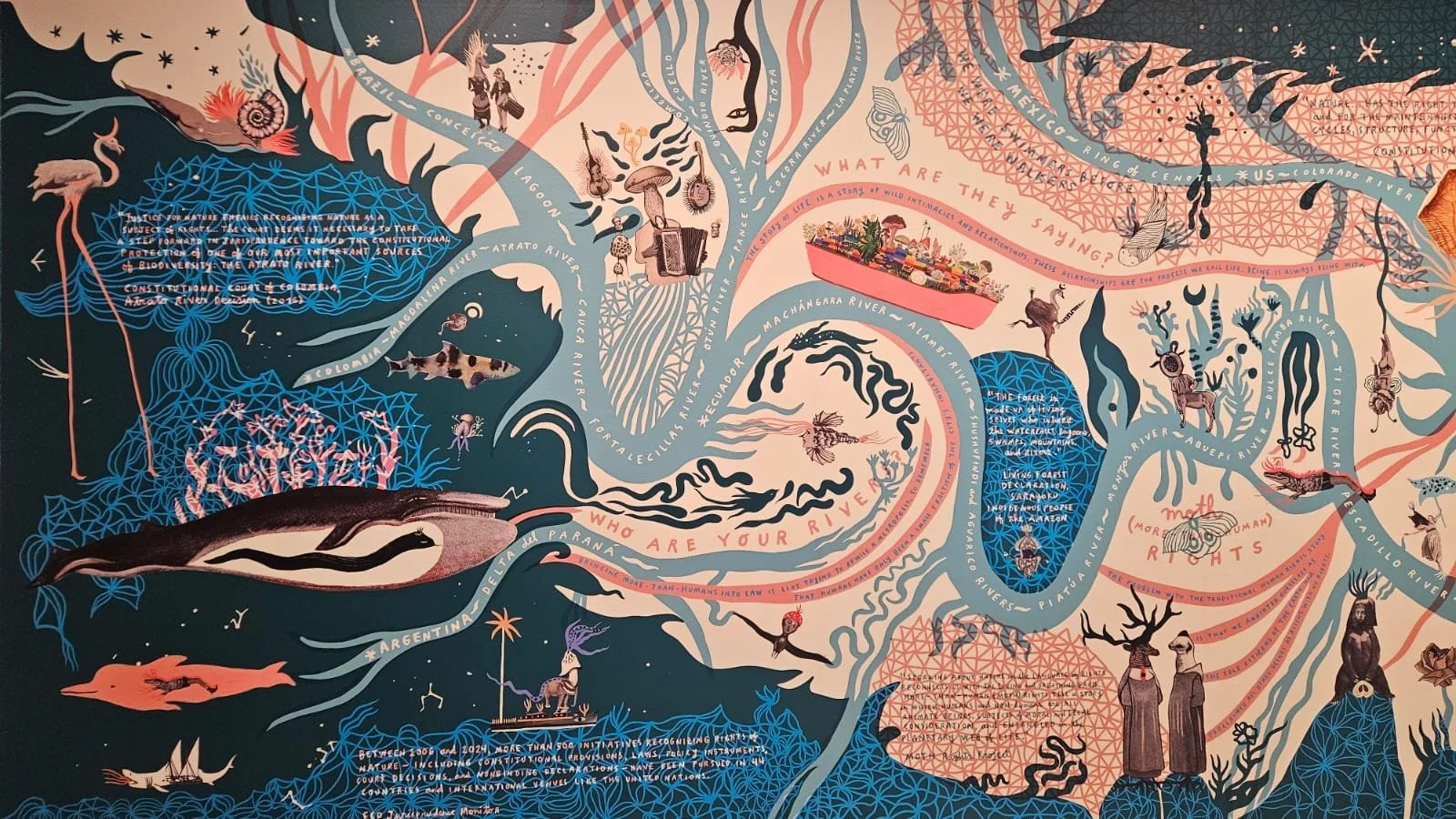
MOTH, “More Than Human Rights Mural” (2025)
Fees
The main impetus of the New School is to untether higher education from its moorings within a system of global debt financing that favours only the wealthy elite, and restore its role as a public service. We are an independent body that is not in receipt of government funding, and we strive to keep costs as low as possible. All of our teachers are paid the same and we execute our own administration speedily and efficiently.
For the September 2026 - June 2027 academic year, the full cost of student tuition remains at £1,850.00 for both home and international applicants who wish to study with us either in-person or online.
Owing to the generosity of Necessity.info and Franc Roddam, we have been pleased to implement a pay-what-you-can-afford donation scheme (PWYCA), subject to a minimum threshold of £200.00. This ensures that no one with the aptitude and desire to participate in the life of the New School need be excluded. (Please note that PWYCA applies in the first instance to 'home' applicants who have been resident in the UK for at least a year prior to joining us. The first tier applies only to those without prior university-level experience and who have not received a commercial (aka private) education.)
We have created the following rough guide to explain the PWYCA scheme and help you decide what to donate relative to your personal circumstances:
All such offers and declarations of circumstances will remain wholly confidential. If an applicant wishes to donate more than the full tuition cost, the sum will help us to prolong the PWYCA scheme for as long as possible. Please contact us should you wish to discuss either this or the question of the minimum threshold payment, should this prove prohibitive. We hold that no one should forgo a critical-creative education owing to economic circumstances alone.
If you are a refugee fleeing from conflict, a care-experienced person over the age of 18, or someone serving a custodial sentence as a consequence of the criminalisation of protest against the climate emergency, we would be pleased to welcome you to NSotA for no tuition fee whatsoever.
There is no closing date for receiving applications. We award places from April onwards until we’re at full capacity, which is typically by early July.
All of our scholars enjoy free admission to Kew Gardens as a result of its community interest company scheme.